Difference between non-oriented silicon steel and grain-oriented silicon steel in terms of professional electrical knowledge

By azhe April 6th, 2025 285 views

Grain-oriented silicon steel has grains predominantly aligned in one direction, with a higher silicon content, and is primarily used in transformer manufacturing. In contrast, non-oriented silicon steel has randomly distributed grains, a lower silicon content, and is mainly used in motor manufacturing. The silicon content is generally distinguished at 3%. Cold-rolled silicon steel is divided into cold-rolled non-oriented silicon steel and cold-rolled grain-oriented silicon steel.
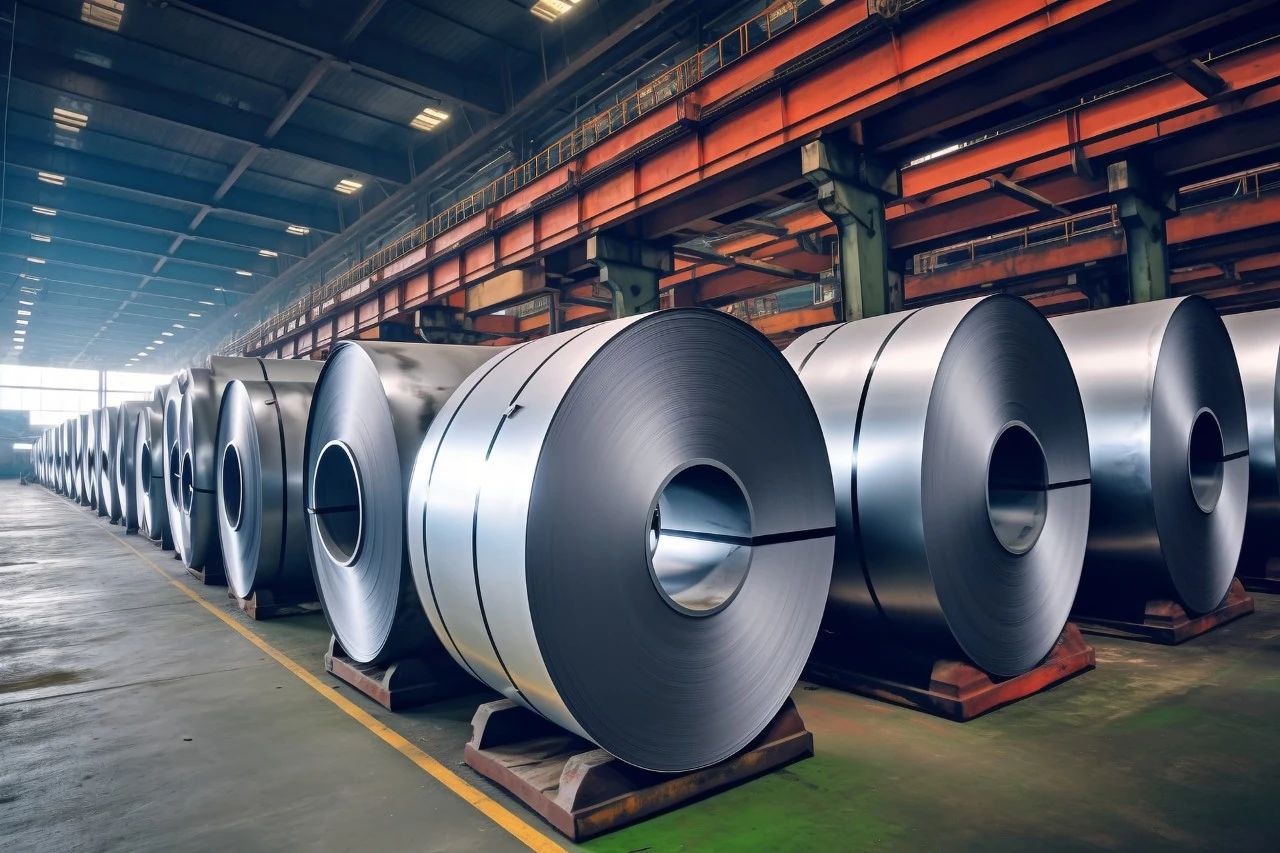
(1) Cold-Rolled Non-Oriented Silicon Steel

The production process requirements for cold-rolled non-oriented silicon steel are relatively lower, with the silicon content ranging from 0.5% to 3.0% by mass fraction. The finished products after cold rolling are typically steel strips with thicknesses of 0.35 mm and 0.5 mm. Its saturation flux density (Bs) is higher than that of grain-oriented silicon steel, with uniform thickness, high dimensional accuracy, smooth and flat surfaces, improving the stacking factor and magnetic properties of the material.

(2) Cold-Rolled Grain-Oriented Silicon Steel

The silicon content in cold-rolled grain-oriented silicon steel exceeds 3.0%, while the carbon content ranges from 0.03% to 0.05%. The steel has low oxide inclusion content and requires inhibitors (e.g., MnS, AlN). Compared to cold-rolled non-oriented silicon steel, grain-oriented silicon steel exhibits lower core loss, highly directional magnetic properties, and superior high magnetic permeability and low loss characteristics in the rolling direction. Cold-rolled grain-oriented silicon steel is also referred to as cold-rolled transformer steel and is primarily used in transformer manufacturing.

Cold-rolled grain-oriented silicon steel can further be classified into two categories: conventional grain-oriented silicon steel (CGO) and high-permeability grain-oriented silicon steel (Hi-B). High-permeability cold-rolled grain-oriented silicon steel is single-oriented steel strip, primarily used in the manufacture of electromagnetic components such as chokes and transformers in electronic instruments.
Properties Comparison

  • Grain-Oriented Silicon Steel: Also known as cold-rolled transformer steel, it is an important ferrosilicon alloy used in the transformer (core) manufacturing industry. It exhibits strong directional magnetic properties, with the lowest core loss, highest magnetic permeability, and high magnetic induction values under specific magnetization fields in the rolling direction. The silicon content is approximately 3%, requiring low oxide inclusion content and the presence of inhibitors (e.g., MnS, AlN).
  • Non-Oriented Silicon Steel: Non-oriented silicon steel is a ferrosilicon alloy with very low carbon content, where the grains in the deformed and annealed steel plate are randomly oriented. It contains 0.8% to 4.8% silicon, and adding silicon increases the resistivity and maximum magnetic permeability of iron while reducing coercive force, core loss (iron loss), and magnetic aging.

Production Process Differences

  • Grain-Oriented Silicon Steel: Produced using oxygen converter smelting, the billet undergoes hot rolling, normalization, cold rolling, intermediate annealing, and secondary cold rolling to achieve the final thickness. It then undergoes decarburization annealing and high-temperature annealing, followed by an insulation coating.
  • Non-Oriented Silicon Steel: Pre-desulfurization of molten iron is performed, and during converter blowing, desulfurization is achieved by adding CaO + CaF₂ flux or rare earth elements and calcium for secondary desulfurization. The boiling molten steel undergoes vacuum treatment for decarburization and further desulfurization. Low-titanium and low-zirconium ferrosilicon is selected for alloying.

Applications of Cold-Rolled Silicon Steel

  • Non-Oriented Silicon Steel:
    • Large Electrical Machinery: Hydro, thermal, and nuclear power units: above 30-50W290; wind turbines: above 30-35W360.
    • Household Appliances: High-efficiency inverter air conditioner compressors: above 30-50W360; high-efficiency inverter refrigerator compressors: above 30-35W360.
    • Medium and Small Electrical Machinery: Y1, Y2, Y3 series and derivative series: low-grade; high-efficiency and ultra-high-efficiency: above 30-35W470.
    • New Energy Vehicles: Drive motors: above 30-35-50W350; micro-motors for new energy vehicles: above 20-35W360.
  • Grain-Oriented Silicon Steel:
    • Transformers: High-end transformers: 750 kV, 1000 kV; mid-to-low-end transformers: 220-500 kV, 110-200 kV, below 110 kV; various grades of energy-saving transformers: 0.18-30 mm.

Cold-rolled grain-oriented thin silicon steel strips are made by pickling, cold rolling, and annealing 0.30 mm or 0.35 mm thick grain-oriented silicon steel strips. Cold-rolled non-oriented silicon steel sheets are produced from billets or continuous casting slabs, hot-rolled into strip coils with a thickness of approximately 2.3 mm. Cold-rolled electrical steel strips exhibit flat surfaces, uniform thickness, high stacking factors, and excellent stamping properties, with higher magnetic flux density and lower core loss compared to hot-rolled electrical steel strips. Replacing hot-rolled strips with cold-rolled strips in motor or transformer manufacturing can reduce weight and volume by 0%-25%. Using cold-rolled grain-oriented strips further improves performance, reducing transformer energy consumption by 45%-50% while ensuring more reliable operation.
Iron loss and copper loss of a transformer
Previous
Iron loss and copper loss of a transformer
Read More
Differences Between Dry-Type Transformers and Oil-Immersed Transformers
Next
Differences Between Dry-Type Transformers and Oil-Immersed Transformers
Read More