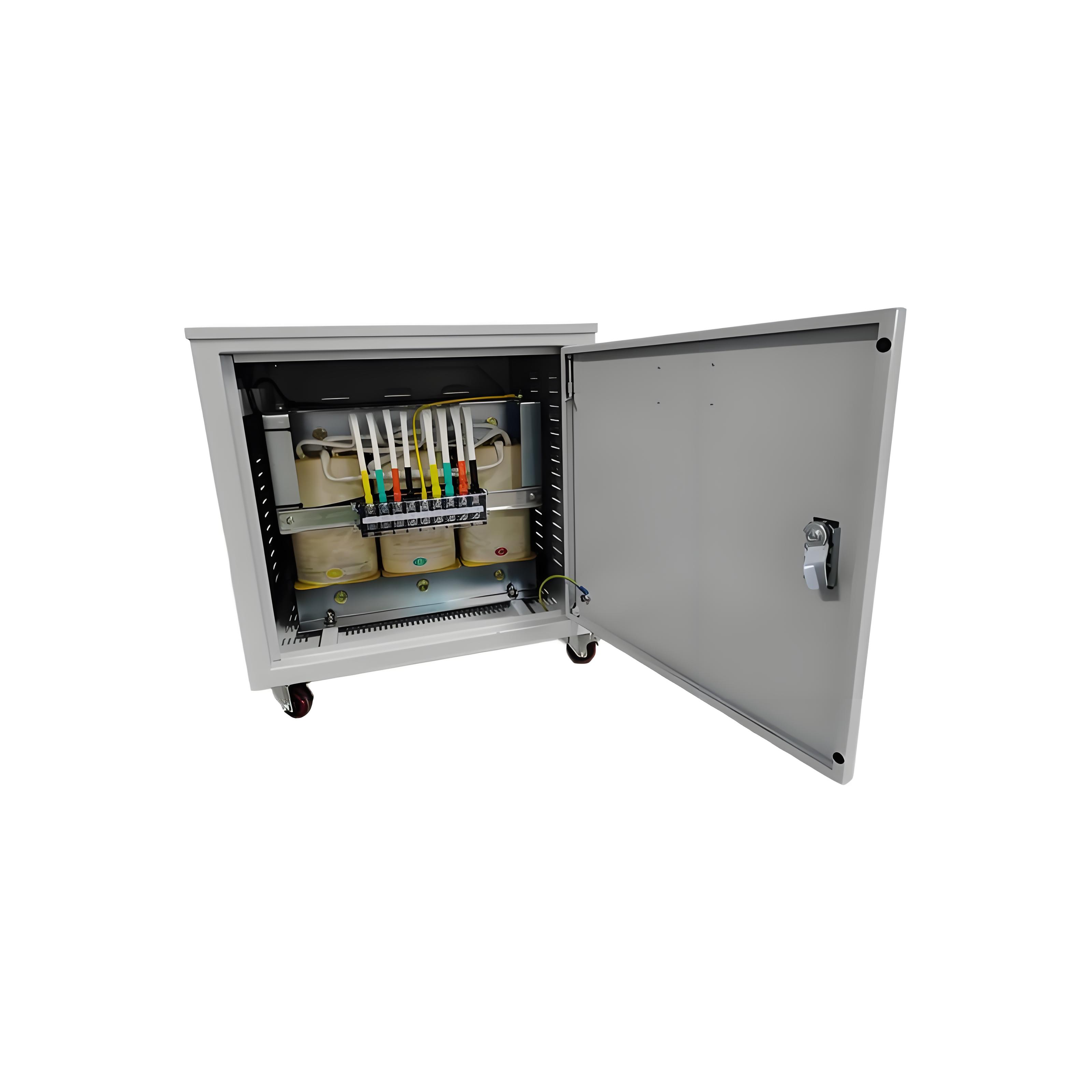
Transformers are one of the most important devices in power systems and are widely used in transmission and distribution networks. Their primary function is to step up or step down voltage levels to meet the energy requirements of different applications. Accurate calculation and proper selection of transformers not only affect the safe and stable operation of the system but also directly impact investment costs and energy efficiency.
Transformers operate based on the principle of electromagnetic induction. They consist of a primary winding, a secondary winding, and an iron core. When alternating current flows through the primary winding, it generates a varying magnetic field in the core, which induces a voltage in the secondary winding. Depending on the turns ratio between the windings, the transformer can either increase or decrease the voltage level.
Load Calculation Method
The capacity of the transformer should meet the maximum load demand with a certain safety margin (usually 20%–30%). The basic formula is:
Where:
Impact of Motor Starting
If the system includes high-power motors that start frequently, the starting current must be considered. An empirical formula can be used:
Future Expansion Consideration
During the design phase, future development needs should be considered. It is generally recommended to reserve more than 20% additional capacity for growth.
Voltage Level Matching
The primary and secondary voltages must match the system voltage, such as common combinations like 10kV/0.4kV or 35kV/10kV.
Cooling Method Selection
Based on the installation environment, choose between dry-type or oil-immersed transformers. Dry-type transformers are suitable for indoor use, while oil-immersed ones are better for outdoor or high-load areas.
Insulation and Protection Ratings
For industrial applications, F or H class insulation is commonly selected, with protection ratings above IP20. In outdoor or humid environments, higher ratings such as IP54 are recommended.
Voltage Regulation Method
Whether to include on-load tap changing (OLTC) depends on the system's stability requirements. OLTC is recommended for critical loads or areas with significant voltage fluctuations.
Energy Efficiency Performance
It is advisable to select high-efficiency, low-loss transformers (such as S11, S13, or amorphous alloy transformers) to reduce no-load and load losses and improve energy utilization.
A factory plans to build a new substation. The total load is known to be 800 kW with a power factor of 0.85, and a 20% increase in load is expected over the next three years.
Total Apparent Power:
Considering Future Expansion and Safety Factor:
Therefore, a 1600 kVA dry-type transformer with good heat dissipation and energy-saving performance is recommended to meet both current and future demands.
Proper calculation and selection of transformers are key to ensuring the safe and economical operation of power systems. In practical engineering, the specific application scenarios, load characteristics, environmental conditions, and future development plans should be comprehensively evaluated to make the optimal choice.