Product Overview
A plant rarely runs at the voltage a catalogue happens to offer; it runs at the voltage already on the wall. This dry-type low voltage transformer is built around that reality. As plant low-voltage transformer manufacturers we are a direct manufacturer with more than 20 years of production behind us, building low-voltage isolation transformers and voltage stabilisers, and every unit is wound, assembled and tested in our own works rather than bought in and re-badged. That matters most on a one-off, because the people who answer your technical questions are the people who wound the coil. Most orders fall into one of three situations: a facility adding capacity to a lighting or control circuit, a maintenance team replacing an ageing transformer whose voltage is no longer obtainable, or an integrator matching imported machinery to a local supply. In each case the unit is expected to drop into the existing panel or enclosure, be labelled on the outgoing circuit, and then simply run.
Key Features
- A low-loss silicon-steel core — The core is stacked from high-permeability silicon steel, which keeps core loss and audible hum down and gives the assembly the mechanical stiffness that quiet running depends on. Less loss also means less heat inside the housing on a unit that may be energised all day.
- Copper or aluminium windings — Windings are produced from high-quality copper or aluminium conductors. Copper gives the better conductivity and usually a cooler, more compact build; aluminium brings the cost down on larger ratings where the extra weight is not a problem.
- Work efficiency of at least 90% — Most of the power you put in reaches the load rather than the casing, so a transformer that is left on around the clock does not quietly turn into a room heater.
- Easy to install — Conductors land on a front terminal panel with input and output clearly marked, so an electrician can wire the unit from the drawing without dismantling it or guessing which side is which.
- Maintenance-free in service — There are no moving parts, no brushes and no cooling fans to service. Keeping the ventilation slots clear and checking terminal tightness at your normal inspection interval is the whole routine.
- Configured for the site, not just the voltage — Units can be adapted for particular environmental conditions and, where the transformer is visible on a plant floor, for an appearance that suits the area around it. Dust, humidity, altitude and available space are all worth mentioning when you order.
- Sized for lighting and control duty — Low voltage transformers for lighting and control circuits are usually the ones nobody thinks about until they stop working. These are built as quiet, dry-type units that can sit close to the load instead of in a remote switch room.
Customer Feedback
Buyers of this family tend to come back with two comments. The first is about fit: customers ordering special builds report that the finished transformer matched the voltages and the space they specified, which is the whole point of winding to order, and several have returned for repeat orders on that basis. The second is about delivery to site — equipment arriving on a dedicated vehicle, being inspected on arrival and going straight into the panel without a rebuild around it.
Facilities that have installed units from this range also remark on how they behave in service: enclosures that do not overheat in a working plant room, sufficient capacity for the load they were specified for, and output that stays where it should. None of that replaces a drawing review for your own installation, but it is what repeat buyers describe.
Installation & Commissioning
- Check the plate against the brief — Before the unit leaves your stores, compare the rating plate on top of the housing with the voltages, rating and insulation class on your order. A mismatch caught here costs nothing; caught at the terminals it costs a day.
- Position it with the vents clear — Mount the transformer level in a dry position, with the side ventilation slots unobstructed and enough room at the front to open the terminal panel. Check the outline drawing against the space before anything is drilled.
- Isolate and land the input — With the supply locked off, bring the incoming conductors to the terminals marked for input, following the red and black pole markings and the warning label. Keep strands out of the terminal block and re-check tightness after the first conductors are in.
- Connect the output and bond the enclosure — Run the outgoing circuit from the output terminals to the load, and bond the housing to the installation's protective earth in the usual way. An isolation transformer still needs its enclosure bonded; separation of the windings does not remove that requirement.
- Test before energising — Check insulation resistance, confirm no tools or swarf are inside the housing, and verify the outgoing circuit is clear before the supply goes back on.
- Energise on no load first — Switch on with the load disconnected and measure the secondary voltage at the output terminals. It should match the figure on the plate; only then connect the load.
- Record and hand over — Note the plate data and the no-load reading in the maintenance file and leave the installation manual with the panel documentation. Where a low voltage lighting transformer is part of a lighting installation, file the secondary voltage with the lighting drawings so the next luminaire change is straightforward.
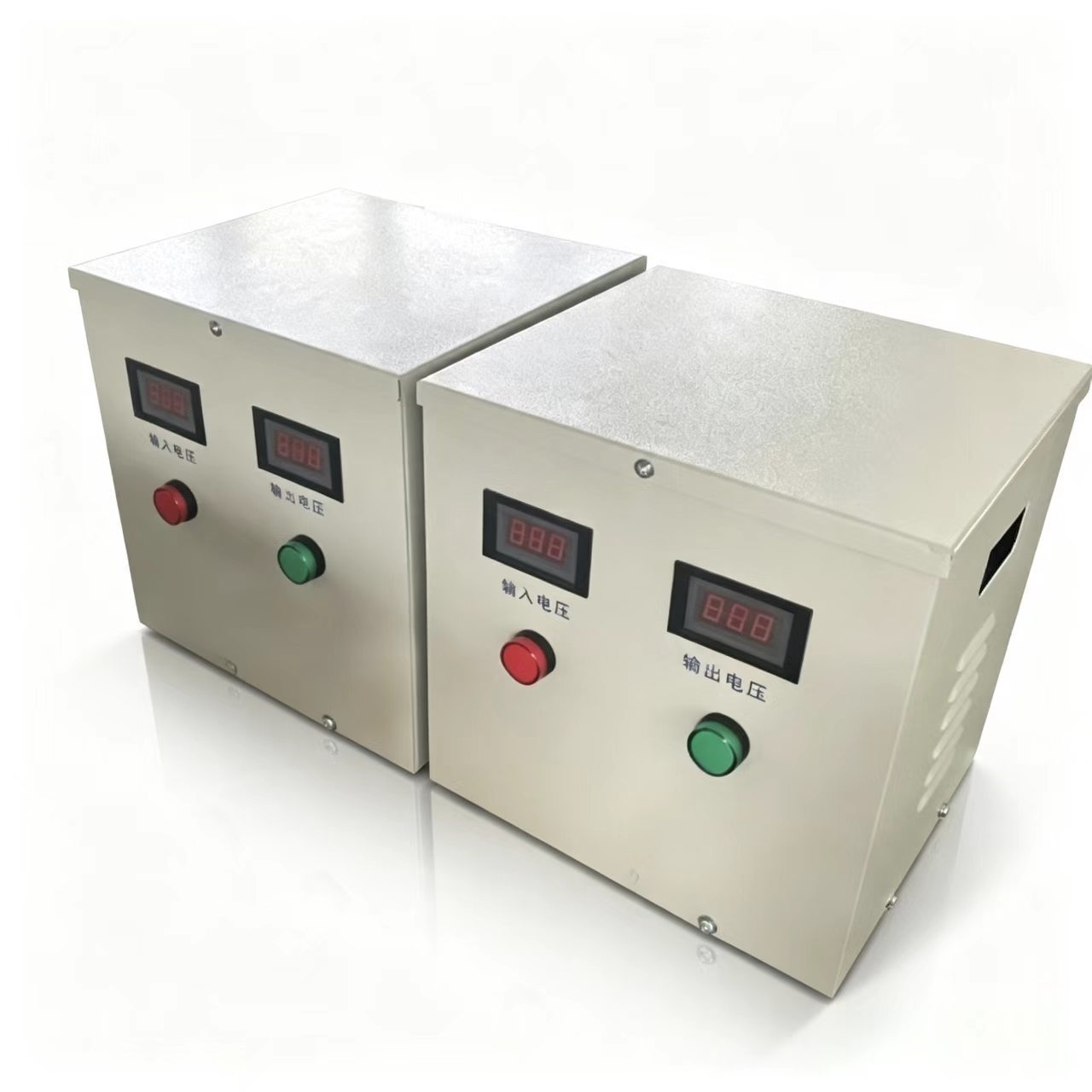
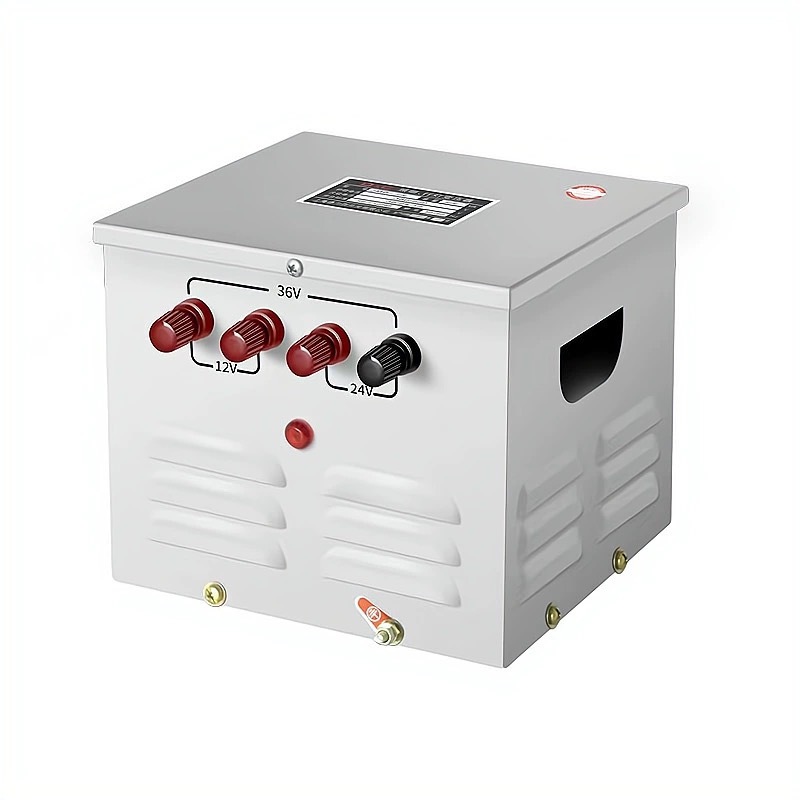
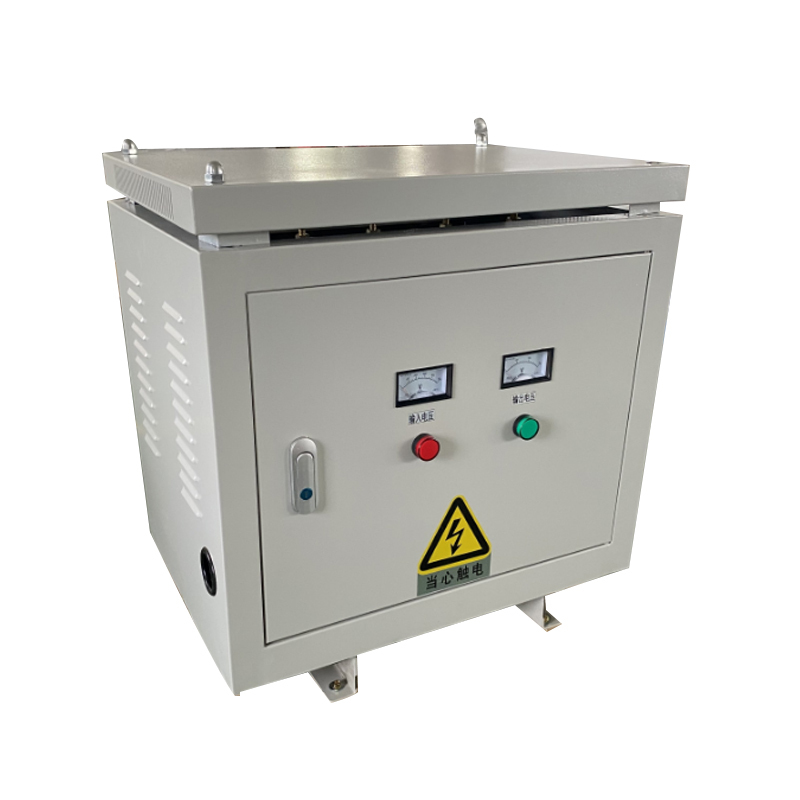
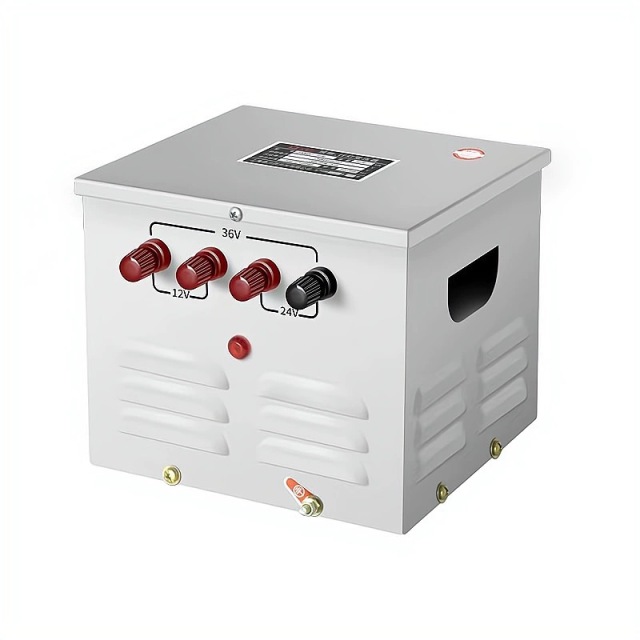
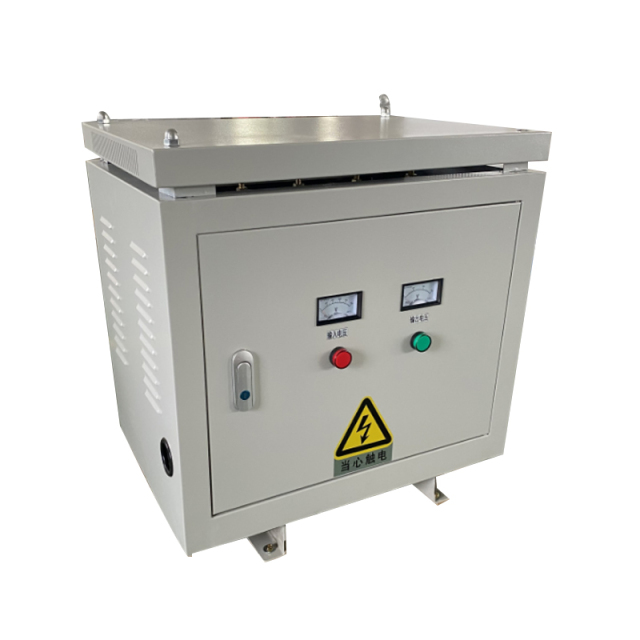
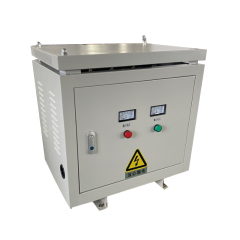
- The core and coil sit inside a sheet-metal housing with a matte painted finish, which protects the winding from knocks and dust on a working plant floor. Convection does the cooling, so the sides carry ventilation slots — leave them unobstructed and keep a little space around the housing when you position the unit. All the wiring happens at the front. The low voltage transformer is landed on a terminal panel that carries separate input and output markings, with red and black terminal caps identifying the poles, so a fitter can connect it from the label rather than from memory. Nothing has to be opened to reach the terminals and the core is never exposed while wiring is going on. A rating plate on the top of the housing carries the electrical data your maintenance file needs, and a hazard warning label is fixed where it can be read before the panel is opened. Because ratings and enclosures differ across the range, check the outline drawing for the exact unit against the space you have — the footprint and terminal positions of a small control-rated transformer are not the same as a facility-sized one.
Plant & Facility Applications
- Lighting circuits in plants and warehouses — A low voltage lighting transformer feeding a run of luminaires brings the distribution voltage down to what the fittings expect, which is often the simplest way to keep an existing lighting layout when the supply around it changes.
- Control and instrumentation supplies — Machine control panels, sensors, relays and instrument loops need a supply separated from the plant distribution; where galvanic separation is required, an isolation transformer mounted at the panel does that job without a separate switch room.
- Workshop and production equipment — Bench tools, test rigs and small machines built for a different voltage run from a transformer sited beside the equipment rather than from a central distribution point.
- Building services and facility equipment — Pumps, door operators, signage, ventilation controls and similar building services frequently sit at a voltage the incoming supply does not provide.
- Temporary and site distribution — Compound lighting, site cabins and temporary workshops get their working voltage from a dry-type unit that can be moved as the job progresses; low voltage transformers for lighting are the most common request on these compounds.
- Like-for-like replacement — Where an existing transformer has failed or its voltage is no longer stocked, the replacement is wound to the same figures and built to suit the space the old one occupied, so the panel does not have to be rebuilt around it.
Specifications
| Power rating | 30 VA to 500 KVA |
| Primary voltage | 1 V to 3000 V, custom values available |
| Secondary voltage | 1 V to 3000 V, custom values available |
| Frequency | 50/60 Hz |
| Insulation class | B / F / H |
| Winding connection | I,i0 / I,i6 / autocoupler |
| Winding material | Copper or aluminium |
| Cooling | Dry-type |
| Rated voltage | 3000 V |
| Insulation strength | > 100 MΩ at 500 V DC |
| Noise | ≤ 60 dB |
| Dielectric strength and impedance | Built to customer specification |
Voltage & Insulation Options
A transformer of this kind is specified by a pair of voltages, not by a model number: so many volts in, so many volts out, at a stated rating. Both windings are wound to order anywhere between 1 V and 3000 V, which means an awkward site voltage is a winding instruction rather than a reason to add a second conversion stage.
Insulation class B, F or H sets how much temperature rise the insulation system is built to tolerate in service. Class B suits ordinary indoor duty in a temperate plant room, class F is the usual choice where the enclosure runs warm or the ambient is higher, and class H is specified for the most demanding locations. Tell us the ambient conditions and how hard the unit will be worked and the class follows from that.
The winding connection is written as I,i0 or I,i6 — two single-phase arrangements that reference the output differently. Send the arrangement your circuit expects, or the drawing of the unit being replaced. Where the load does not need galvanic separation, the autocoupler version shares one winding instead of providing two, which makes it smaller, lighter and lower in cost; where separation is essential, it is not the right choice.
Dielectric strength and impedance are not fixed catalogue values on this range — they are built to the figure your specification calls for, so include the test voltage or impedance target with your enquiry if your project states one. And where lighting dominates the load, say so early: low voltage transformers for lighting are usually sized on the continuous lighting load with headroom for start-up, and that changes the rating we would suggest.
Ordering & Delivery
- Send the electrical brief — Power rating, primary and secondary voltage, frequency, insulation class, winding connection, and whether the load needs a true isolation transformer or the autocoupler version is acceptable. Add any site conditions such as altitude, ambient temperature or a confined enclosure. A technical drawing is the fastest starting point; if you do not have one, those figures are enough to work from.
- Receive the quote — We normally return a detailed quote within 24 hours of the enquiry, and a custom solution from the engineering team within 48 hours. Email JSD@jsd-voltagetransformer.com or message +86 135 1660 7609 on WhatsApp for immediate assistance.
- Place the order — The minimum order quantity is 1 set. Payment can be made by TT, electronic payment, ACH, SEPA, SWIFT, Alipay, WeChat Pay or prepaid card.
- Production — Lead time is 3 to 25 working days, depending on the order quantity and the complexity of the customization. As plant low-voltage transformer manufacturers we schedule winding and test slots against your required date rather than against a stock list.
- Packing and dispatch — Units ship in international wooden cases, or packed according to the actual transport needs of the shipment. Tell us if the site has restricted access or limited unloading equipment so the packing plan suits it.
- Warranty — Every unit carries a minimum 12-month warranty, with extended warranty options available depending on project requirements.
Technical Support & Model Matching
Because we build in our own factory, the engineers who answer your questions are the same people who configure the units on the line. Send us your input and output voltages, load, frequency and site conditions, and we will match the right model or design a custom unit to suit. Our team stays with you from first enquiry through installation and commissioning, helps trace faults, and specifies spare or replacement units for equipment already in service. Twenty years of manufacturing know-how sits behind that support, so the technical answer comes with a build you can rely on.
- 100% inspection, not sampling — Every unit is inspected rather than checked as part of a batch, so a custom build carries the same inspection weight as a repeat order.
Eight checkpoints across production — From raw material warehousing to finished product delivery, eight dedicated quality-control checkpoints follow the unit through the process, covering incoming conductor and lamination material, core stacking, winding, insulation and connections, assembly into the housing, and the finished electrical tests before packing.
Tested on the finished unit — Insulation strength, output voltage at the specified input and audible noise are demonstrated on the assembled transformer, not assumed from the design sheet. A unit that fails a checkpoint is held back rather than moved forward.
The plate travels with the unit — The rating plate fixed to the housing carries the data your maintenance file needs, so what was tested and what was delivered stay the same record.
Standards position — Manufacturing follows IEC 60076 and EN 61558-2-4, and our transformer factory holds CE and UL5085 certification. Because approvals and documentation requirements differ between markets and between projects, tell us which standard or approval governs your installation and we will confirm in writing what can be supplied against it before you order.
Made under one roof — Drawing alignment, winding, assembly and testing all happen in house. If something changes after the drawing is approved, it is changed by the same team that wound the coil.
FAQ
Can this transformer run on both 50 Hz and 60 Hz supplies?
Yes. The low voltage transformer is built for 50/60 Hz operation, so the same design works on a 50 Hz European supply and on 60 Hz equipment supplies without a separate build. Frequency is confirmed together with the voltages when the order is placed, because it belongs to the winding specification rather than being an accessory you add later.
How much noise will it make if it sits near a work area?
The published sound level is 60 dB or below. In practice the hum comes from the core laminations, which is why the core is stacked from high-permeability silicon steel and built for structural stiffness — a loosely stacked core is the usual reason a transformer becomes the loudest thing in the room. Mounting matters as much as the unit: fixed to a thin steel panel or a resonant wall, any transformer sounds louder than it does on a solid base. Tell us where it will sit, and we will take that into account when we confirm the build.
Can the unit feed a lighting circuit on its own?
Yes, and it is one of the most common duties for this range. A low voltage lighting transformer is normally specified on the continuous lighting load with a margin for start-up, and the output is matched to the luminaires rather than to the distribution supply. If the lighting is split across several circuits, energise and check each run in turn at commissioning, so a fault on one run is not mistaken for a transformer problem.
What do you need if the old unit has no readable rating plate?
Measure the incoming voltage, confirm what the load requires, and send the rating in VA or kVA along with the outline dimensions of the space the old unit occupied. As plant low-voltage transformer manufacturers we build replacements from those figures routinely, and a photograph of the old nameplate, the panel it sat in or the machine it fed usually settles whatever is left. You do not need a drawing to start.
Which standards is the unit built to, and will they be accepted in our market?
Manufacturing follows IEC 60076 and EN 61558-2-4, and our transformer factory holds CE and UL5085 certification. Approval and documentation requirements vary between markets and between individual projects, so tell us which standard or approval governs your installation and we will confirm in writing what can be supplied against it before the order is placed rather than after.